Wazua
»
SME
»
Finance
»
Sale of substantial Eucalyptus trees Investment
Rank: Member Joined: 5/15/2019 Posts: 694 Location: planet earth
|
Gathige wrote:
The Chinese proverb "The best time to plant a tree was twenty years ago. The second best time is today" comes handy for you. If you have a good chunk of land in the highlands where they do well, you can give it a trial.
Good luck
@Gathige. Asante sana for the encouragement brother. Will give it a trial and see how things go. I love the fact that once established, this is a "low maintenance crop" for the most part. 6 years on..the second and only other Wazua Billionaire!! Mungu ni nguvu yetu🙏🏾🇰🇪🔥🔥!
|
|
|
Rank: Elder Joined: 3/18/2011 Posts: 12,069 Location: Kianjokoma
|
Cypress in 5 years?  On eucalyptus, a friend of mine who got into it before I did was telling me how he'd sell each tree at sijui 10 or 7k. That was around 2009 when he ventured So last year, many of his trees had matured. The offers?2k a piece! He refused to sell. But later, he was badly in need of cash so when some brokers came calling offering the same 2k, he didn't even bargain The good thing is they paid him for his 1000 trees even before harvesting. A cool 2M for his first harvest without any haggling! Not bad.
|
|
|
Rank: Member Joined: 5/15/2019 Posts: 694 Location: planet earth
|
Lolest! wrote:Cypress in 5 years? On eucalyptus, a friend of mine who got into it before I did was telling me how he'd sell each tree at sijui 10 or 7k. That was around 2009 when he ventured So last year, many of his trees had matured. The offers?2k a piece! He refused to sell. But later, he was badly in need of cash so when some brokers came calling offering the same 2k, he didn't even bargain The good thing is they paid him for his 1000 trees even before harvesting. A cool 2M for his first harvest without any haggling! Not bad. So this guy is lying about 5 years?  https://web.facebook.com...218336/?_rdc=1&_rdr https://web.facebook.com...218336/?_rdc=1&_rdr
If so, what varieties mature within 5-10 years and have excellent quality timber? Never sell to a broker, bradza, that is the worst one can do. This is why I say better to control the product from womb to the pram. 6 years on..the second and only other Wazua Billionaire!! Mungu ni nguvu yetu🙏🏾🇰🇪🔥🔥!
|
|
|
Rank: Elder Joined: 3/18/2011 Posts: 12,069 Location: Kianjokoma
|
amorphous wrote:Lolest! wrote:Cypress in 5 years? On eucalyptus, a friend of mine who got into it before I did was telling me how he'd sell each tree at sijui 10 or 7k. That was around 2009 when he ventured So last year, many of his trees had matured. The offers?2k a piece! He refused to sell. But later, he was badly in need of cash so when some brokers came calling offering the same 2k, he didn't even bargain The good thing is they paid him for his 1000 trees even before harvesting. A cool 2M for his first harvest without any haggling! Not bad. So this guy is lying about 5 years? https://web.facebook.com...218336/?_rdc=1&_rdr
If so, what varieties mature within 5-10 years and have excellent quality timber? Never sell to a broker, bradza, that is the worst one can do. This is why I say better to control the product from womb to the pram. You could be right, my search yielded this testimony from Eldoret Quote:For power and fencing poles, it can be harvested at between five and 12 years when a single tree can sell for up to Sh10,000.
Timber trees fetch a lot more depending on the number of feet one produces. Cypress timber currently sells at an average of Sh66 a foot, one of the priciest in the market. A 30-year-old tree can produce an average of 2,000 feet. Quote:Of all the tree species I grow, none has given me as much grief as Cypress (Cypresus lusitanica). Since 2005, I have planted about 1,000 mainly on my farm in Soy, Uasin Gishu but I have lost nearly all of them. Read about his challenges here https://www.nation.co.ke...ery-delicate-tree-252642
|
|
|
Rank: Member Joined: 10/26/2008 Posts: 380
|
Cypress trees take at least 15-20 years to mature. That said its still a plan. I am looking for 1-2 acres somewhere near Kijabe, or aberdares for this purpose. amorphous wrote:villageseer wrote:Kaigangio wrote:@ villageseer,
you see village the first mistake you made when planting those trees is not knowing who will buy them poles...
KPLC and REA do not buy raw (untreated) poles...
my advice...go to GTI (Gilgil Telecommunications Institute, formerly owned by KPTC) in Gilgil town, Marura Power poles treatment factory (about 8km from sagana town on your way to nairobi).
Also check another treatment site just about 2km from Kekopey township on your way to nakuru.
...hope that will help. kaigangio Thanks for your advise,but I can assure you I did thorough homework when I came to learn about the new venture that had recently at that time (2003) being introduced in the country for smallholder farmers who could alternatively invest in tree planting as subsitute of already pathetic situation of existing cash crops products(Coffee & Tea) in Central Province. I can assure you those of us who took the risk did thorough research of the existing markets, locally and internationally . We knew the value of the Kenya market of treated transmission wood poles at that time was around 4 billion shilling annually (estimated to be around Ksh 7 billion now). And in most cases the KPLC had to import the product from Europe, Far East, South Africa and our neighbouring countries - Uganda, Tanzania and DRC. This new hybrid seedlings (clones Eucalyptus seedling that would reach its maturity within a period of 5-7 years for the transmission poles instead of the conventional trees that takes 15-20 years to mature) was being imported from South Africa, through collaboration of Kenya ( KEFRI -under Kenya Biotechnology Programme Trust) and South Africa governments( through a South Africa multinational paper company that owned thousand acres of forest plantations for its paper mills) and funded by a British organization known as Gatsby Trust and US'ISSSA(Remember the Bananas tissue technology of JKUAT?) Anyway, from outset we knew that there was a big demand of the product and even there was and still even today publication depicting of what you would make from planting these trees from KEFRI people. Their publication stated that after three years of planting their seelings , you could fetch an average of Ksh3,000 per tree in selling it as telephone pole to Kenya Post AND Telecommunication. And if you wait for 5 years, you could sell it KPLC at least for a minimum of Ksh10,000.00 But what we never reckoned at that time and even now was the kind of resistance we would face from the existing Cartel that had for years controlled this market and with assistance of top management of these two firms. Made of a minimum of 4 to 6 major companies in energy industry, these guys are quite ruthless. Even after the Parliement in 2008 or 2009 had passed a motion that KPLC should initially source their transmission poles locally before venturing internatinally, the management did totally ignored this, and even after its Board of Directors also, passed a resolution of the same in 2009, and even after KEFRI through its Biotechnology Programme Project had organized the farmers as Forest Growers Association - that could negotiate for them as legal entity in putting a bid at KPLC or Rural Electrification. And even after both of them (KPLC &REA) had invited the organization to put an EOI Tender in January 2010, that they could be able to supply them treated poles. After submitting our collective Bid as an organization and led by KEFRI, the tender was opened in March 18th 2010 and that was the last time we had from them. So Kagaingio, I hope with that little background , you would be able to see what sometimes you have to go through when you are faced with an almost monopolistic and cut-throat type of business. We thank God for some of these old threads. A true treasure trove of valuable info! Asanteni sana to all of you who have contributed! Jameni, villageseer please update us on what happened here? I feel your pain kabisha kabisha. I can imagine everything you went through, expecting a goodly 50m and then the cartel politics turned it upside down. As they say, this is Kiinya (TIK)..not surprised but it is very sad these msukosukos happened to you. The million dollar question is, what did you eventually do with the trees?On my end I plan to plant plain old cypress. Was at my timber shop juzi buying 2 by 2s and the tiny things were going for a shocking 25 bob a foot before transport! Meaning all I need to do is grow a good size of acres worth of Cypress, hire a very kali Masai moran to guard them, a caretaker to water during the dry season, and wait 5 years, before milling the wood myself and selling on Namanga rd by myself. Si nitatajirika mbaya mboff jameni? 1 huge cypress tree can produce thousands of feet of 2x2s. So imagine 10k trees  Even after carrying costs jameni this should be a roaring profit of a deal because I will be vertically integrated from seedling to timber board with zero middle men. And we all know DC is construction central sasa ivi so no shortage of customers especially if I undercut all these tunjamaas here who are selling us overpriced wood we can get from Kitui and elsewhere at many shillings less per foot. Hebu wacha nijipange jameni, time and life wait for no man. Swenani, who was that guy you were asking aangalie mkate yake ya eliot inasema nini, aniangalilie kama hii gitu ginawesekana.
|
|
|
Rank: Member Joined: 5/15/2019 Posts: 694 Location: planet earth
|
Thank you both for the articles and feedback. Worth a try regardless. 6 years on..the second and only other Wazua Billionaire!! Mungu ni nguvu yetu🙏🏾🇰🇪🔥🔥!
|
|
|
Rank: Member Joined: 5/15/2019 Posts: 694 Location: planet earth
|
Inspiring!  The queen of trees The queen of treesQuote:By ERIC WAINAINA More by this Author The weather is sunny as Rose Makimei walks on a narrow path cutting through indigenous trees, shrubs and wild fruits on her farm in Gituamba village, Kiambu County. 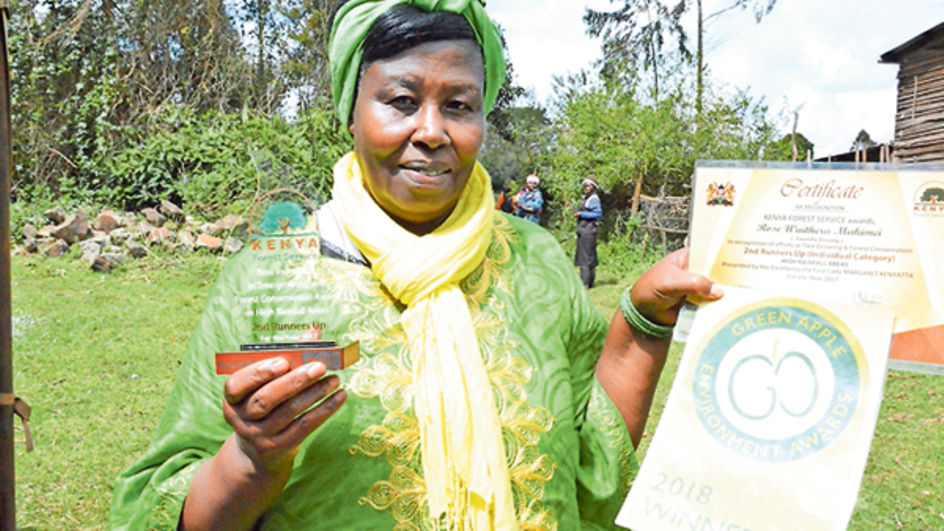 As the retired hotelier uses her right hand to push aside the shrubs, birds chirp, seemingly acknowledging her presence. Next to the thicket is a plantation of pine and cypress trees planted three by three metres apart, creating a canopy.
The 3,000 eight-year-old trees, 1, 500 pines and 1, 500 cypress, Makimei says, sit on two acres, part of her land, where she also grows eucalyptus, grevillea robusta, pears and plums, as well as vegetables. She further rears 15 sheep. Makimei is a seasoned tree farmer, a venture that she has engaged in since 2005, when she retired. “I planted 3,000 eucalyptus trees soon after retirement after buying each at Sh20 to ensure my land is not idle,” she says. Though she did not plan to sell them, three years later a buyer surfaced, seeking the trees to use in construction industry. Makimei harvested 2,200 trees that she sold at Sh100 each because they were smaller in size. “I realised that even though I had planted the trees to conserve the environment, I could still make good money from them,” she tells Seeds of Gold. Encouraged, she planted 3,000 more eucalyptus trees, which earned her up to Sh500,000.
“The money was all profit because after buying the seedlings and taking care of them at the initial stage, you do not incur any other cost,” she says. She chanced upon an opportunity to work with the Kenya Forest Service, which was willing to provide free tree seedlings to land owners, who would later allow their farms to be demonstration centres. “I was lucky to ink the deal, getting the 1,500 pine and 1, 500 cypress trees. KFS provided me with the seedlings and brought in youth who did the planting. In the deal, KFS was to look for loggers to buy them at set prices,” she explains. EFFORTS IN PLANTING TREES, CONSERVING FORESTS She is projecting that in the next three years when the trees mature, she will earn between Sh21 million and Sh30 million, with a mature tree fetching between Sh7,000 and Sh10,000.Joseph Mureithi, the principal of the Waruhiu Agricultural Development Centre in Githunguri, Kiambu, notes that tree planting is a viable venture that has economic and environmental benefits, adding that instead of leaving the land idle, one should grow them. “With the increasing population, there is a high demand for wood products such as timber and poles, therefore, a tree farmer will definitely make a killing from such a venture.”
Ms Makimei indicates towards a section of pine trees she grows in her farm in Lari, Kiambu County. She additionally grows cypress and eucalyptus trees. PHOTO | ERIC WAINAINA | NMG Makimei teaches various groups how to plant trees and take care of them. She says that seedlings must be planted in a two-feet-deep and two-feet-wide hole, and the distance from one tree to another should be eight feet. “You should put in manure in the hole and mulch the seedlings. If there is rain, the seedlings grow firm in one to two months. If there is no rain, it should be watered once in three days.” At seven months to one year, one should prune the branches of the trees at half the length of the tree. “In second and third years, we prune to three-quarters the length of the tree. This allows the tree to grow taller and to thicken up,” she says. At year four or five, the farmer again has to prune to three-quarter the length of the tree. From year six to 10, the tree grows freely to maturity. Due to her efforts to conserve the environment, Makimei has earned recognition nationally and globally. In 2014, she won the Total Eco-Challenge Award, which is organised by Total Kenya, for her sustained efforts in planting trees and conserving forests, where she also keeps bees in 40 hives, harvesting honey from 10 that she sells at Sh700 per kilo. Last year, she was the second runner-up in the Kenya Forest Service awards and was honoured by First Lady Margaret Kenyatta for her tree-growing efforts. She also received the Green Apple award due to her environmental best practices in a ceremony that was held at the UK Houses of Parliament in Westminster, London, where she was named the Green Apple 2019 ambassador. Source: https://www.nation.co.ke...e-queen-of-trees-141474
I am increasingly getting obsessed with this thing, just the way my obsession with DC started once I saw the incredible untapped opportunities there. My obsession is slowly growing perhaps even to the point I might start a "why tree farming is the future" superthread  What I love, love, loooove about this tree venture thing. 1. It is time/patience intensive, much like DC property/land. Time is the great "weeder out" (pun intended) of competition. This is why most grow sukuma wiki instead of rare fruit trees that take 5-10 years to mature. Most just want quick money but quick easy money can never match with long range, patient money. To plant and wait 7, 10 or even 15 years is something most Kenyans cannot do, which means competition itakuwa ndogo sana. Meanwhile population is growing and people are building. Where will their timber come from. If we are already importing timber and banning logging from time to time, this tells me there is a *huge sweet spot* here. 2. It is NOT labour intensive Ati all I need to do is order seedlings from KEFRI, dig holes and plant, weka manure, mulch, prune every few months for the first few years, spray once in a while and just sit on my behind to wait? Jameni this pales in comparison to almost any other venture out there. 3. Superprofits for little inputs self explanatory 4. Product control I like businesses that give me total control from greenfield to end user. Hakuna kubahatisha kabisha kabisha 5. No financing neededUpfront costs for a landowner are next to zero 6. Trees are beautiful who does not like trees? I can do something in the middle of those trees and charge Nairobi middle classes and forest-loving msungus good money to experience the African BUSH in all its glory hapo hapo 7. Trees change the microclimate Fresh air, less need for water dependence. Heck, I might not even need to drill a borehole at all on the land, which will save me incredible upfront amounts 8. If all else fails I can build my bunker humo humo even as this world-going-kurazy with corona and other pandemics to come goes to the dogs!! Good luck finding me humo humo in my labyrinth of trees and underground tunnels!!! NIMESEMA!6 years on..the second and only other Wazua Billionaire!! Mungu ni nguvu yetu🙏🏾🇰🇪🔥🔥!
|
|
|
Rank: Member Joined: 5/15/2019 Posts: 694 Location: planet earth
|
https://www.google.com/u...amp;cshid=1595406905449
There seems to be a lot of differences in the estimated maturity period for Cypress. 6 years on..the second and only other Wazua Billionaire!! Mungu ni nguvu yetu🙏🏾🇰🇪🔥🔥!
|
|
|
Rank: Member Joined: 5/15/2019 Posts: 694 Location: planet earth
|
|
|
|
Rank: Member Joined: 5/15/2019 Posts: 694 Location: planet earth
|
 Jameni if I supply a paltry 100 million ngwanyes worth of mbao to this deficit, makosa iko wabi? 6 years on..the second and only other Wazua Billionaire!! Mungu ni nguvu yetu🙏🏾🇰🇪🔥🔥!
|
|
|
Wazua
»
SME
»
Finance
»
Sale of substantial Eucalyptus trees Investment
Forum Jump
You cannot post new topics in this forum.
You cannot reply to topics in this forum.
You cannot delete your posts in this forum.
You cannot edit your posts in this forum.
You cannot create polls in this forum.
You cannot vote in polls in this forum.
|