Wazua
»
Club SK
»
Politics
»
Mau evictees:its payback time
Rank: Elder Joined: 10/4/2006 Posts: 13,823 Location: Nairobi
|
murchr wrote:Trees take water from the soil and release it into the atmosphere. Tree leaves also act as interceptors, catching falling rain, which then evaporates causing rain precipitation elsewhere —evapo-transpiration
This is what happens in Drc Kericho Mauritius etc it's not agreed upon... Quote:Life depends on Earth's hydrological cycle, especially the processes that carry moisture from oceans to land. The role of vegetation remains controversial. Local people in many partially forested regions believe that forests “attract” rain, whereas most modern climate experts would disagree. But a new hypothesis suggests that local people may be correct.
The world's hydrological systems are changing rapidly. Food security in many regions is heavily threatened by changing rainfall patterns (Lobell et al. 2008). Meanwhile, deforestation has already reduced vapor flows derived from forests by almost five percent (an estimated 3000 cubic kilometers [km3] per year of a global terrestrial derived total of 67,000 km3), with little sign of slowing (Gordon et al. 2005). The need for understanding how vegetation cover influences climate has never been more urgent.
Makarieva and Gorshkov have developed a hypothesis to explain how forests attract moist air and how continental regions such as the Amazon basin remain wet (Makarieva et al. 2006, Makarieva and Gorshkov 2007, and associated online discussions; hereafter, collectively “Makarieva and Gorshkov”). The implications are substantial. Conventional models typically predict a “moderate” 20 to 30 percent decline in rainfall after continental-scale deforestation (Bonan 2008). In contrast, Makarieva and Gorshkov suggest that even relatively localized clearing might ultimately switch entire continental climates from wet to arid, with rainfall declining by more than 95 percent in the interior. my thoughts are - it's a mix... majority of the rainfall is ocean related.... that's why it rains in the oceans ambapo hakuna miti  on land - it's a huge percentage ocean rain modified by relief (mostly seasonal rain) and some convectional rain all year round. All Mushrooms are edible! Some Mushroom are only edible ONCE!
|
|
|
Rank: Elder Joined: 2/26/2012 Posts: 15,980
|
masukuma wrote:murchr wrote:Trees take water from the soil and release it into the atmosphere. Tree leaves also act as interceptors, catching falling rain, which then evaporates causing rain precipitation elsewhere —evapo-transpiration
This is what happens in Drc Kericho Mauritius etc it's not agreed upon... Quote:Life depends on Earth's hydrological cycle, especially the processes that carry moisture from oceans to land. The role of vegetation remains controversial. Local people in many partially forested regions believe that forests “attract” rain, whereas most modern climate experts would disagree. But a new hypothesis suggests that local people may be correct.
The world's hydrological systems are changing rapidly. Food security in many regions is heavily threatened by changing rainfall patterns (Lobell et al. 2008). Meanwhile, deforestation has already reduced vapor flows derived from forests by almost five percent (an estimated 3000 cubic kilometers [km3] per year of a global terrestrial derived total of 67,000 km3), with little sign of slowing (Gordon et al. 2005). The need for understanding how vegetation cover influences climate has never been more urgent.
Makarieva and Gorshkov have developed a hypothesis to explain how forests attract moist air and how continental regions such as the Amazon basin remain wet (Makarieva et al. 2006, Makarieva and Gorshkov 2007, and associated online discussions; hereafter, collectively “Makarieva and Gorshkov”). The implications are substantial. Conventional models typically predict a “moderate” 20 to 30 percent decline in rainfall after continental-scale deforestation (Bonan 2008). In contrast, Makarieva and Gorshkov suggest that even relatively localized clearing might ultimately switch entire continental climates from wet to arid, with rainfall declining by more than 95 percent in the interior. my thoughts are - it's a mix... majority of the rainfall is ocean related.... that's why it rains in the oceans ambapo hakuna miti on land - it's a huge percentage ocean rain modified by relief (mostly seasonal rain) and some convectional rain all year round. The article agrees with evapo transpiration What say you about Dubai? "There are only two emotions in the market, hope & fear. The problem is you hope when you should fear & fear when you should hope: - Jesse Livermore
.
|
|
|
Rank: Elder Joined: 10/4/2006 Posts: 13,823 Location: Nairobi
|
murchr wrote:masukuma wrote:murchr wrote:Trees take water from the soil and release it into the atmosphere. Tree leaves also act as interceptors, catching falling rain, which then evaporates causing rain precipitation elsewhere —evapo-transpiration
This is what happens in Drc Kericho Mauritius etc it's not agreed upon... Quote:Life depends on Earth's hydrological cycle, especially the processes that carry moisture from oceans to land. The role of vegetation remains controversial. Local people in many partially forested regions believe that forests “attract” rain, whereas most modern climate experts would disagree. But a new hypothesis suggests that local people may be correct.
The world's hydrological systems are changing rapidly. Food security in many regions is heavily threatened by changing rainfall patterns (Lobell et al. 2008). Meanwhile, deforestation has already reduced vapor flows derived from forests by almost five percent (an estimated 3000 cubic kilometers [km3] per year of a global terrestrial derived total of 67,000 km3), with little sign of slowing (Gordon et al. 2005). The need for understanding how vegetation cover influences climate has never been more urgent.
Makarieva and Gorshkov have developed a hypothesis to explain how forests attract moist air and how continental regions such as the Amazon basin remain wet (Makarieva et al. 2006, Makarieva and Gorshkov 2007, and associated online discussions; hereafter, collectively “Makarieva and Gorshkov”). The implications are substantial. Conventional models typically predict a “moderate” 20 to 30 percent decline in rainfall after continental-scale deforestation (Bonan 2008). In contrast, Makarieva and Gorshkov suggest that even relatively localized clearing might ultimately switch entire continental climates from wet to arid, with rainfall declining by more than 95 percent in the interior. my thoughts are - it's a mix... majority of the rainfall is ocean related.... that's why it rains in the oceans ambapo hakuna miti on land - it's a huge percentage ocean rain modified by relief (mostly seasonal rain) and some convectional rain all year round. The article agrees with evapo transpiration What say you about Dubai? the reason I quoted the abstract of that paper is because Quote:The role of vegetation remains controversial. Local people in many partially forested regions believe that forests “attract” rain, whereas most modern climate experts would disagree. But a new hypothesis suggests that local people may be correct. it's not agreed upon that vegetation 'attracts' rain. Dubai and the whole arabian peninsular are high pressure regions! All Mushrooms are edible! Some Mushroom are only edible ONCE!
|
|
|
Rank: Elder Joined: 2/26/2012 Posts: 15,980
|
masukuma wrote:murchr wrote:masukuma wrote:murchr wrote:Trees take water from the soil and release it into the atmosphere. Tree leaves also act as interceptors, catching falling rain, which then evaporates causing rain precipitation elsewhere —evapo-transpiration
This is what happens in Drc Kericho Mauritius etc it's not agreed upon... Quote:Life depends on Earth's hydrological cycle, especially the processes that carry moisture from oceans to land. The role of vegetation remains controversial. Local people in many partially forested regions believe that forests “attract” rain, whereas most modern climate experts would disagree. But a new hypothesis suggests that local people may be correct.
The world's hydrological systems are changing rapidly. Food security in many regions is heavily threatened by changing rainfall patterns (Lobell et al. 2008). Meanwhile, deforestation has already reduced vapor flows derived from forests by almost five percent (an estimated 3000 cubic kilometers [km3] per year of a global terrestrial derived total of 67,000 km3), with little sign of slowing (Gordon et al. 2005). The need for understanding how vegetation cover influences climate has never been more urgent.
Makarieva and Gorshkov have developed a hypothesis to explain how forests attract moist air and how continental regions such as the Amazon basin remain wet (Makarieva et al. 2006, Makarieva and Gorshkov 2007, and associated online discussions; hereafter, collectively “Makarieva and Gorshkov”). The implications are substantial. Conventional models typically predict a “moderate” 20 to 30 percent decline in rainfall after continental-scale deforestation (Bonan 2008). In contrast, Makarieva and Gorshkov suggest that even relatively localized clearing might ultimately switch entire continental climates from wet to arid, with rainfall declining by more than 95 percent in the interior. my thoughts are - it's a mix... majority of the rainfall is ocean related.... that's why it rains in the oceans ambapo hakuna miti on land - it's a huge percentage ocean rain modified by relief (mostly seasonal rain) and some convectional rain all year round. The article agrees with evapo transpiration What say you about Dubai? the reason I quoted the abstract of that paper is because Quote:The role of vegetation remains controversial. Local people in many partially forested regions believe that forests “attract” rain, whereas most modern climate experts would disagree. But a new hypothesis suggests that local people may be correct. it's not agreed upon that vegetation 'attracts' rain. Dubai and the whole arabian peninsular are high pressure regions! Now - Surely when did evapo transpiration become "attracting rain"? 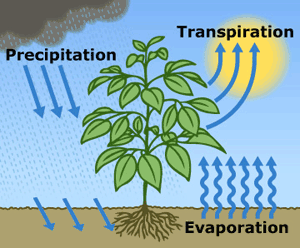 The article you posted also says Quote:Observations suggest that extensive deforestation often reduces cloud formation and rainfall, and accentuates seasonality (Bonan 2008). Forest clearings can cause a distinct, convection-driven “vegetation breeze” in which moist air is drawn out of the forest (Laurance 2005). Atmospheric turbulence resulting from canopy roughness and temperature-driven convection are thought to explain the localized increase in rainfall sometimes associated with fragmented forest cover
In equatorial climates, forests maintain higher evaporation rates than other cover types, including open water. Thus, forests draw in moist air from elsewhere; the larger the forest area, the greater the volumes of moist air drawn in (see figure 1). This additional moisture rises and condenses in turn, generating a positive feedback in which a large proportion of the water condensing as clouds over wet areas is drawn in from elsewhere.
"There are only two emotions in the market, hope & fear. The problem is you hope when you should fear & fear when you should hope: - Jesse Livermore
.
|
|
|
Rank: Elder Joined: 10/4/2006 Posts: 13,823 Location: Nairobi
|
murchr wrote:masukuma wrote:murchr wrote:masukuma wrote:murchr wrote:Trees take water from the soil and release it into the atmosphere. Tree leaves also act as interceptors, catching falling rain, which then evaporates causing rain precipitation elsewhere —evapo-transpiration
This is what happens in Drc Kericho Mauritius etc it's not agreed upon... Quote:Life depends on Earth's hydrological cycle, especially the processes that carry moisture from oceans to land. The role of vegetation remains controversial. Local people in many partially forested regions believe that forests “attract” rain, whereas most modern climate experts would disagree. But a new hypothesis suggests that local people may be correct.
The world's hydrological systems are changing rapidly. Food security in many regions is heavily threatened by changing rainfall patterns (Lobell et al. 2008). Meanwhile, deforestation has already reduced vapor flows derived from forests by almost five percent (an estimated 3000 cubic kilometers [km3] per year of a global terrestrial derived total of 67,000 km3), with little sign of slowing (Gordon et al. 2005). The need for understanding how vegetation cover influences climate has never been more urgent.
Makarieva and Gorshkov have developed a hypothesis to explain how forests attract moist air and how continental regions such as the Amazon basin remain wet (Makarieva et al. 2006, Makarieva and Gorshkov 2007, and associated online discussions; hereafter, collectively “Makarieva and Gorshkov”). The implications are substantial. Conventional models typically predict a “moderate” 20 to 30 percent decline in rainfall after continental-scale deforestation (Bonan 2008). In contrast, Makarieva and Gorshkov suggest that even relatively localized clearing might ultimately switch entire continental climates from wet to arid, with rainfall declining by more than 95 percent in the interior. my thoughts are - it's a mix... majority of the rainfall is ocean related.... that's why it rains in the oceans ambapo hakuna miti on land - it's a huge percentage ocean rain modified by relief (mostly seasonal rain) and some convectional rain all year round. The article agrees with evapo transpiration What say you about Dubai? the reason I quoted the abstract of that paper is because Quote:The role of vegetation remains controversial. Local people in many partially forested regions believe that forests “attract” rain, whereas most modern climate experts would disagree. But a new hypothesis suggests that local people may be correct. it's not agreed upon that vegetation 'attracts' rain. Dubai and the whole arabian peninsular are high pressure regions! Now - Surely when did evapo transpiration become "attracting rain"? The article you posted also says Quote:Observations suggest that extensive deforestation often reduces cloud formation and rainfall, and accentuates seasonality (Bonan 2008). Forest clearings can cause a distinct, convection-driven “vegetation breeze” in which moist air is drawn out of the forest (Laurance 2005). Atmospheric turbulence resulting from canopy roughness and temperature-driven convection are thought to explain the localized increase in rainfall sometimes associated with fragmented forest cover
In equatorial climates, forests maintain higher evaporation rates than other cover types, including open water. Thus, forests draw in moist air from elsewhere; the larger the forest area, the greater the volumes of moist air drawn in (see figure 1). This additional moisture rises and condenses in turn, generating a positive feedback in which a large proportion of the water condensing as clouds over wet areas is drawn in from elsewhere.
That's why I said... Quote: on land - it's a huge percentage ocean rain modified by relief (mostly seasonal rain) and some convectional rain all year round. if you cut down all trees - you will still have seasonal rain (the one that has nothing to do with vegetation) but you will lack the 'all year round' rain in some high altitude areas namely 'convectional' rain. All Mushrooms are edible! Some Mushroom are only edible ONCE!
|
|
|
Rank: Elder Joined: 2/26/2012 Posts: 15,980
|
masukuma wrote:murchr wrote:masukuma wrote:murchr wrote:masukuma wrote:murchr wrote:Trees take water from the soil and release it into the atmosphere. Tree leaves also act as interceptors, catching falling rain, which then evaporates causing rain precipitation elsewhere —evapo-transpiration
This is what happens in Drc Kericho Mauritius etc it's not agreed upon... Quote:Life depends on Earth's hydrological cycle, especially the processes that carry moisture from oceans to land. The role of vegetation remains controversial. Local people in many partially forested regions believe that forests “attract” rain, whereas most modern climate experts would disagree. But a new hypothesis suggests that local people may be correct.
The world's hydrological systems are changing rapidly. Food security in many regions is heavily threatened by changing rainfall patterns (Lobell et al. 2008). Meanwhile, deforestation has already reduced vapor flows derived from forests by almost five percent (an estimated 3000 cubic kilometers [km3] per year of a global terrestrial derived total of 67,000 km3), with little sign of slowing (Gordon et al. 2005). The need for understanding how vegetation cover influences climate has never been more urgent.
Makarieva and Gorshkov have developed a hypothesis to explain how forests attract moist air and how continental regions such as the Amazon basin remain wet (Makarieva et al. 2006, Makarieva and Gorshkov 2007, and associated online discussions; hereafter, collectively “Makarieva and Gorshkov”). The implications are substantial. Conventional models typically predict a “moderate” 20 to 30 percent decline in rainfall after continental-scale deforestation (Bonan 2008). In contrast, Makarieva and Gorshkov suggest that even relatively localized clearing might ultimately switch entire continental climates from wet to arid, with rainfall declining by more than 95 percent in the interior. my thoughts are - it's a mix... majority of the rainfall is ocean related.... that's why it rains in the oceans ambapo hakuna miti on land - it's a huge percentage ocean rain modified by relief (mostly seasonal rain) and some convectional rain all year round. The article agrees with evapo transpiration What say you about Dubai? the reason I quoted the abstract of that paper is because Quote:The role of vegetation remains controversial. Local people in many partially forested regions believe that forests “attract” rain, whereas most modern climate experts would disagree. But a new hypothesis suggests that local people may be correct. it's not agreed upon that vegetation 'attracts' rain. Dubai and the whole arabian peninsular are high pressure regions! Now - Surely when did evapo transpiration become "attracting rain"? The article you posted also says Quote:Observations suggest that extensive deforestation often reduces cloud formation and rainfall, and accentuates seasonality (Bonan 2008). Forest clearings can cause a distinct, convection-driven “vegetation breeze” in which moist air is drawn out of the forest (Laurance 2005). Atmospheric turbulence resulting from canopy roughness and temperature-driven convection are thought to explain the localized increase in rainfall sometimes associated with fragmented forest cover
In equatorial climates, forests maintain higher evaporation rates than other cover types, including open water. Thus, forests draw in moist air from elsewhere; the larger the forest area, the greater the volumes of moist air drawn in (see figure 1). This additional moisture rises and condenses in turn, generating a positive feedback in which a large proportion of the water condensing as clouds over wet areas is drawn in from elsewhere.
That's why I said... Quote: on land - it's a huge percentage ocean rain modified by relief (mostly seasonal rain) and some convectional rain all year round. if you cut down all trees - you will still have seasonal rain (the one that has nothing to do with vegetation) but you will lack the 'all year round' rain in some high altitude areas namely 'convectional' rain. Who argued with that....incase you missed it I was just stating how trees cause precipitation too and are important. Countering the mvua inatoka mbinguni "There are only two emotions in the market, hope & fear. The problem is you hope when you should fear & fear when you should hope: - Jesse Livermore
.
|
|
|
Rank: Elder Joined: 7/28/2015 Posts: 9,562 Location: Rodi Kopany, Homa Bay
|
So what brings about the other? Is it the forests that bring about rain or the rain that brings about forests? The fact is that if an area receives rain above a certain amount (about 1000mm per yr) trees dominate and form forests. The water evaporates from the ocean/lakes and condenses as it moves inland and encounters mountains/highlands falling as rain. And that is why all highland areas whose "mountains" cool the air moisture and make if fall as rain end up with forests e.g mt kenya, elgon, kilimanjaro, aberdares, taita, mau etc. Therefore it will still rain even if you clear off all forest from mt kenya. Also, even if you planted a billion trees in kitui, it still wont make it rain. Thus its rains that bring about forests not forests bringing rain. 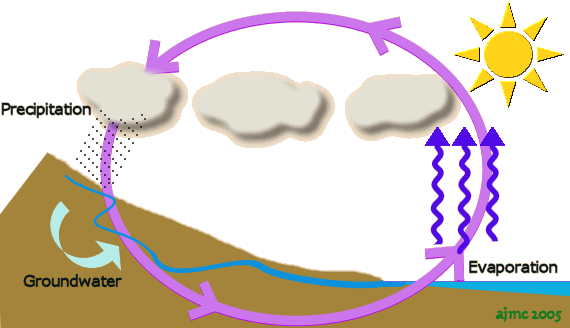
|
|
|
Rank: Elder Joined: 7/28/2015 Posts: 9,562 Location: Rodi Kopany, Homa Bay
|
murchr wrote:masukuma wrote:murchr wrote:masukuma wrote:murchr wrote:masukuma wrote:murchr wrote:Trees take water from the soil and release it into the atmosphere. Tree leaves also act as interceptors, catching falling rain, which then evaporates causing rain precipitation elsewhere —evapo-transpiration
This is what happens in Drc Kericho Mauritius etc it's not agreed upon... Quote:Life depends on Earth's hydrological cycle, especially the processes that carry moisture from oceans to land. The role of vegetation remains controversial. Local people in many partially forested regions believe that forests “attract” rain, whereas most modern climate experts would disagree. But a new hypothesis suggests that local people may be correct.
The world's hydrological systems are changing rapidly. Food security in many regions is heavily threatened by changing rainfall patterns (Lobell et al. 2008). Meanwhile, deforestation has already reduced vapor flows derived from forests by almost five percent (an estimated 3000 cubic kilometers [km3] per year of a global terrestrial derived total of 67,000 km3), with little sign of slowing (Gordon et al. 2005). The need for understanding how vegetation cover influences climate has never been more urgent.
Makarieva and Gorshkov have developed a hypothesis to explain how forests attract moist air and how continental regions such as the Amazon basin remain wet (Makarieva et al. 2006, Makarieva and Gorshkov 2007, and associated online discussions; hereafter, collectively “Makarieva and Gorshkov”). The implications are substantial. Conventional models typically predict a “moderate” 20 to 30 percent decline in rainfall after continental-scale deforestation (Bonan 2008). In contrast, Makarieva and Gorshkov suggest that even relatively localized clearing might ultimately switch entire continental climates from wet to arid, with rainfall declining by more than 95 percent in the interior. my thoughts are - it's a mix... majority of the rainfall is ocean related.... that's why it rains in the oceans ambapo hakuna miti on land - it's a huge percentage ocean rain modified by relief (mostly seasonal rain) and some convectional rain all year round. The article agrees with evapo transpiration What say you about Dubai? the reason I quoted the abstract of that paper is because Quote:The role of vegetation remains controversial. Local people in many partially forested regions believe that forests “attract” rain, whereas most modern climate experts would disagree. But a new hypothesis suggests that local people may be correct. it's not agreed upon that vegetation 'attracts' rain. Dubai and the whole arabian peninsular are high pressure regions! Now - Surely when did evapo transpiration become "attracting rain"? The article you posted also says Quote:Observations suggest that extensive deforestation often reduces cloud formation and rainfall, and accentuates seasonality (Bonan 2008). Forest clearings can cause a distinct, convection-driven “vegetation breeze” in which moist air is drawn out of the forest (Laurance 2005). Atmospheric turbulence resulting from canopy roughness and temperature-driven convection are thought to explain the localized increase in rainfall sometimes associated with fragmented forest cover
In equatorial climates, forests maintain higher evaporation rates than other cover types, including open water. Thus, forests draw in moist air from elsewhere; the larger the forest area, the greater the volumes of moist air drawn in (see figure 1). This additional moisture rises and condenses in turn, generating a positive feedback in which a large proportion of the water condensing as clouds over wet areas is drawn in from elsewhere.
That's why I said... Quote: on land - it's a huge percentage ocean rain modified by relief (mostly seasonal rain) and some convectional rain all year round. if you cut down all trees - you will still have seasonal rain (the one that has nothing to do with vegetation) but you will lack the 'all year round' rain in some high altitude areas namely 'convectional' rain. Who argued with that....incase you missed it I was just stating how trees cause precipitation too and are important. Countering the mvua inatoka mbinguni You are right and wrong. Right in that trees and other vegetation like crops, herbs, grass etc do transpire and also add moisture into the atmosphere. The trees will not cause precipitation but will only modify the hydrological cycle. Therefore planting a billion trees in kitui will enrich the clouds with moisture as they move to go and condense in mt kenya and this will result in more rain huko nyeri, embu and meru. 
|
|
|
Rank: Elder Joined: 7/28/2015 Posts: 9,562 Location: Rodi Kopany, Homa Bay
|
Planting trees is actually a BAD idea because they remove water from an area. https://forestsnews.cifo...stricken-regions?fnl=en
Quote:The relationship between forests and water is complex because, at the local level, catchment studies show that trees actually remove water from the system.
Growing trees take water from the soil and release it into the atmosphere. Tree leaves also act as interceptors, catching falling rain, which then evaporates causing rain precipitation elsewhere — a process known as evapo-transpiration.
|
|
|
Rank: Elder Joined: 10/3/2008 Posts: 4,058 Location: Gwitu
|
hardwood wrote:Planting trees is actually a BAD idea because they remove water from an area. https://forestsnews.cifo...stricken-regions?fnl=en
Quote:The relationship between forests and water is complex because, at the local level, catchment studies show that trees actually remove water from the system.
Growing trees take water from the soil and release it into the atmosphere. Tree leaves also act as interceptors, catching falling rain, which then evaporates causing rain precipitation elsewhere — a process known as evapo-transpiration. Please read the entire article. Truth forever on the scaffold
Wrong forever on the throne
(James Russell Rowell)
|
|
|
Wazua
»
Club SK
»
Politics
»
Mau evictees:its payback time
Forum Jump
You cannot post new topics in this forum.
You cannot reply to topics in this forum.
You cannot delete your posts in this forum.
You cannot edit your posts in this forum.
You cannot create polls in this forum.
You cannot vote in polls in this forum.
|